Reconstitution is the moment where careful chemistry either preserves a peptide or silently degrades it. Done well, the vial behaves exactly as its Certificate of Analysis predicts. Done poorly, every downstream measurement inherits an invisible error term.
The protocol below covers the standard bench procedure for reconstituting a lyophilised peptide with bacteriostatic water (BAC water) — including the arithmetic, the sterile handling, and the storage regime that keeps the resulting stock stable.
What to have ready before you start
- The lyophilised peptide vial, brought to room temperature (see below).
- Sterile bacteriostatic water — 0.9% benzyl alcohol in laboratory-grade water.
- A sterile syringe fitted with a 25-gauge or finer needle.
- 70% isopropanol alcohol swabs.
- A clean bench — ideally a laminar-flow hood, at minimum a wiped and uncluttered work surface.
- A calibrated pipette or graduated syringe for aliquoting the final solution.
Warm the vial to room temperature first
Peptide vials come straight out of −20 °C storage. Cracking the seal on a cold vial in a warmer room lets moisture condense against the inner glass — which begins hydrolysing the peptide before any diluent is added. Give the vial 20–30 minutes on the bench to equilibrate before you break the seal.
Working out the dilution
The reconstitution volume is a design choice, not a fixed number. Choose whatever volume gives a convenient working concentration for the way you will dispense the material. Two worked examples make the arithmetic concrete.
A larger reconstitution volume gives more forgiving dispensing precision; a smaller one concentrates the peptide and extends the useful life of a refrigerated stock. Match the volume to the protocol, not the other way round.
Step-by-step reconstitution
- Wipe the rubber stopper of both the peptide vial and the BAC water vial with a fresh alcohol swab. Allow 15 seconds of air-drying.
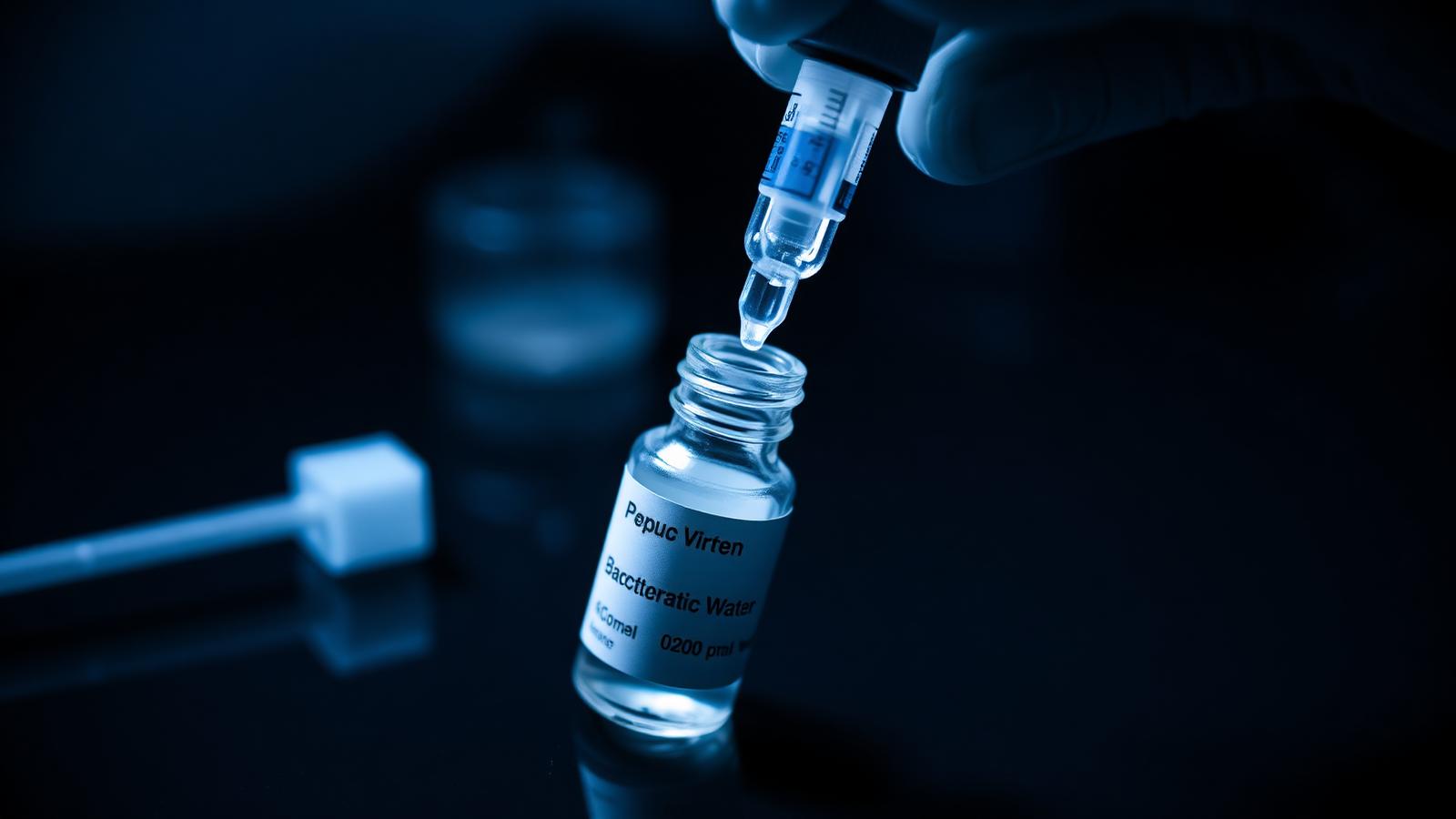
- Draw the chosen volume of BAC water into the syringe. Push out any large air bubbles.
- Insert the needle through the peptide vial's stopper. Angle the needle so the BAC water will run down the inner glass wall — do not point it directly at the lyophilised pellet.
- Depress the plunger slowly. Never inject BAC water at pressure onto the powder — the mechanical impact damages the peptide backbone.
- Withdraw the syringe. Do not shake the vial. Swirl it gently or leave it undisturbed for 60–90 seconds until dissolution is complete. A clear, colourless solution is the target.
- If any powder is still visible after two minutes of gentle swirling, warm the vial briefly between your palms and swirl again. Never vortex or sonicate a peptide solution.
Storing the reconstituted vial
Bacteriostatic water is preserved with 0.9% benzyl alcohol, which suppresses microbial growth in a multi-use vial for roughly 28 days under refrigeration. That figure represents the practical ceiling on how long a peptide should remain in liquid form.
- Keep the reconstituted vial at 2–8 °C, upright, in a dark refrigerator compartment.
- For any protocol that extends beyond four weeks, aliquot the reconstituted stock into sterile microcentrifuge tubes and freeze them at −20 °C. Thaw each aliquot once, on ice.
- Never re-freeze a thawed aliquot. Repeated freeze-thaw cycles fragment the peptide backbone.
- Label every aliquot with peptide name, lot number, concentration, and reconstitution date. Future-you will be grateful.
Common mistakes worth avoiding
- Reconstituting a cold vial without equilibrating to room temperature.
- Using tap water, saline, or unqualified sterile water without confirming the peptide's solubility requirements.
- Firing BAC water straight onto the lyophilised powder under pressure.
- Vortexing or shaking the vial in an attempt to "help" the peptide dissolve.
- Leaving reconstituted stock at room temperature between uses.