The Certificate of Analysis is the single most important document that accompanies a research peptide. It converts a supplier's marketing claim into a measurable, batch-specific value that any competent laboratory can verify. Yet many groups still treat it as filing paperwork rather than data — and forfeit the ability to interpret their own results as a consequence.
This guide unpacks what HPLC purity actually measures, what each field on a Certificate of Analysis is telling you, and why the difference between 95% and ≥99% is the difference between defensible data and a study that will not replicate.
What HPLC is actually measuring
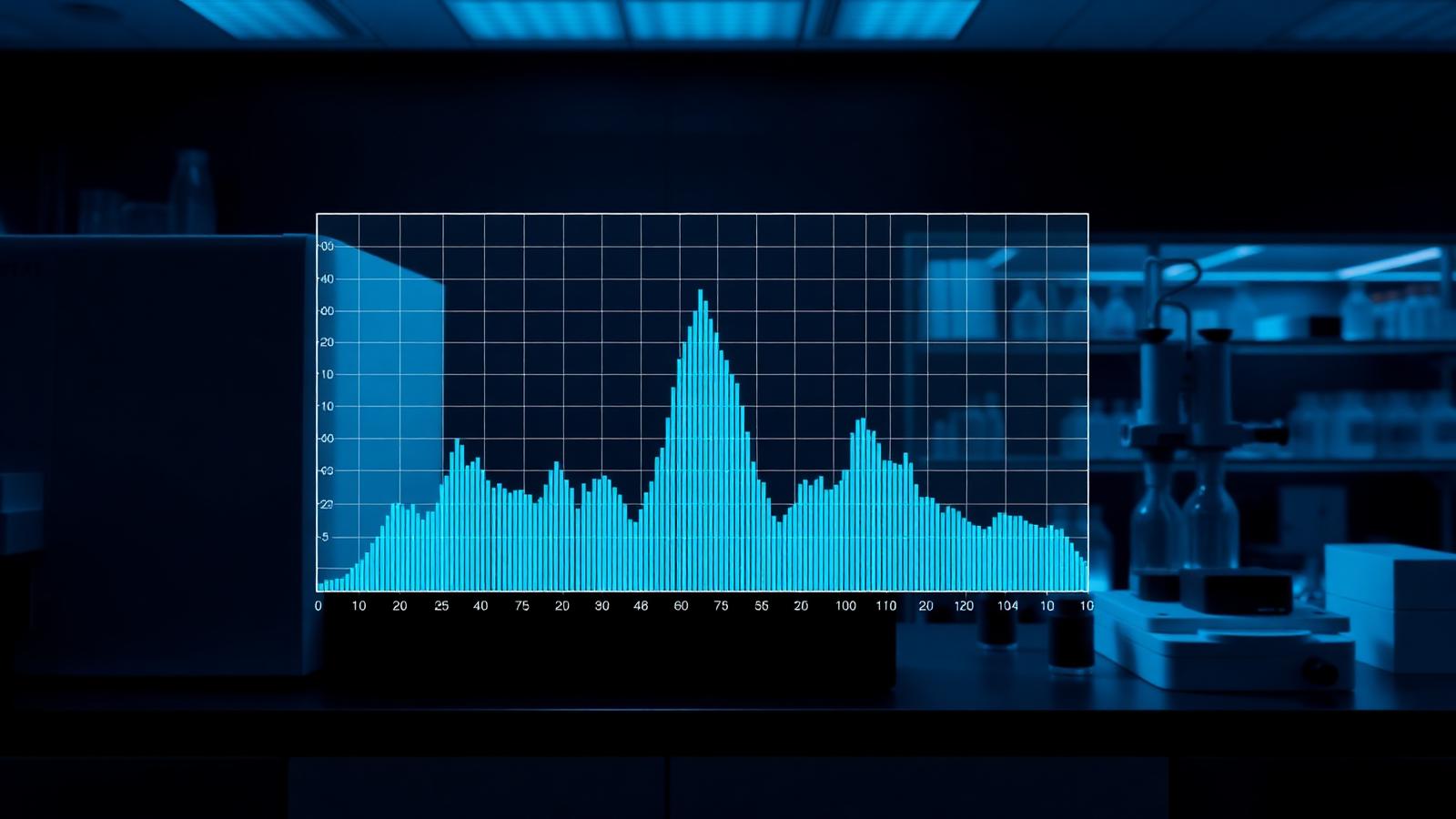
High-performance liquid chromatography separates the components of a sample by driving them through a column packed with a stationary phase. Different molecules interact with that phase for different durations and therefore elute at different retention times. A UV detector at the column outlet records absorbance and produces the familiar chromatogram of peaks on a time axis.
The area under the target peptide's peak divided by the total area of all peaks yields the purity percentage. That is the number that appears on the Certificate of Analysis. A single tall peak on a flat baseline is what ≥99% purity looks like in practice.
Reading the Certificate of Analysis
A properly prepared COA carries at least the following fields:
- Product name and molecular formula, so you can confirm the compound is the one you ordered.
- Batch or lot number, tying the analysis to the specific vial in your hand.
- HPLC purity percentage, generally reported to one decimal place (for example 99.4%).
- Retention time and column conditions, so another laboratory could reproduce the analysis.
- Mass-spectrometry data confirming that the molecular weight matches the theoretical value for the sequence.
- Appearance (colour, physical form), test method, and a quality-control signature or reference.
Why 95% is not "basically 99%"
The step from 95% to 99% is not a linear four percentage points. It is a fivefold reduction in impurity load — from 5% to 1% — and those impurities are anything but inert. Almost by construction, they are molecules structurally close to the target: truncated sequences, deletion peptides, and side-reaction adducts.
In a receptor binding assay those look-alike species compete for the same pocket and distort IC50 values. In cell-based work they generate background signalling at concentrations high enough to shift the mean. Each individual experiment still "works" — and no two batches replicate cleanly.
Where the ≥99% threshold matters most
- Dose-response work, where impurities distort the low-dose baseline first.
- Batch-to-batch comparisons, where impurity variation becomes a systematic error term.
- Long-duration protocols, where accumulated exposure to impurities is more likely to hit secondary targets.
Beyond purity: the rest of the COA
A complete COA also reports water content, acetate or trifluoroacetate counter-ion content, and residual solvent levels. All three of these change the effective peptide mass in a reconstituted stock: a vial labelled 10 mg can contain closer to 8.5 mg of peptide once water and counter-ion are subtracted. Serious quantitative work always uses net peptide content, not gross vial mass.
How Noctera runs quality control
Every Noctera batch is analysed by reverse-phase HPLC and confirmed by mass spectrometry before it leaves the facility. Purity is reported to one decimal place and must clear ≥99% to be released. The batch-specific COA is available on request for every vial shipped, and lot numbers are tracked through fulfilment so a researcher can always link the paperwork to the vial in the freezer.